Thursday, April 23, 2009

Inspirational Image Of The Day - Andres Parada

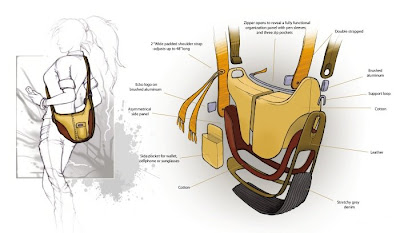
Andres-Parada-concept-development-wacom-design-exposed-design-exposed-industrial-designAndres Parada's digital rendering is a great way to start the day. Andres over the shoulder bag concept for Echo Unltd. began as a pen sketch on paper. He then took it into Photoshop and rendered a concept that became more than a concept, he illustrated a bag that has its own personality.Andres-Parada-concept-development-wacom-design-exposed-design-exposed-industrial-design-2
From a materials standpoint the design is comprised of denim, leather, a cotton weave, and brushed aluminum for fasteners. Andres has done an excellent job of portraying different materials using color, value, and texture. The details Andres has illustrated are very important to the success of the design. The stitching and fastening points, as well as the double shoulder strap all speak to the type of designer Andres is. The detail presented in his sketches, material choices, and added lifestyle image all work to define how well Andres understands the process of creating an over the shoulder bag. He hasn't left the details to the seamstress or someone else to define. His ability to present a detailed and understood concept disarms the client and allows them to gauge the aesthetic value of the design and not whether he understands cut and sew techniques.

Wednesday, April 22, 2009

Sea-Doo GTI

Joe-Ellice-seadoo-development-industrial-design-designexposed-design-exposedJoe Ellice of Sheboygan Wisconsin is keeping the green theme going with his design for the Sea-Doo GTI. Joe indicates that the Sea-Doo GTI is meant for family fun. Joe communicates this persona with the design form language. The soft gentle forms, playful graphics, and inspirations derived from wildlife (star fish & sea rays) found its way into the design language of the GTI. A great amount of emphasis was placed upon comfort and ergonomics. This is specifically noted in the organic features of the seat and rear handle.Joe-Ellice-seadoo-development-industrial-design-designexposed-design-exposed-2The images you see here are only a small cross section of the images Joe gathered for inspiration. He researched and assembled the images above to create an inspirational image board that would provide him with the visual representations of the physical form language he aspired to develop for the GTI. This element of the creative process isn't as easy as just surfing the net for random images and grouping them together. The purpose of an image board is to provide yourself with targeted images that you draw inspiration from throughout the creative process. Another reason you may do this is to ensure that you develop a unique and consistent form language.Joe-Ellice-seadoo-development-industrial-design-designexposed-design-exposed-3The inspirational image board Joe assembled has apparently not led him astray. By reviewing each of the black & white photographs and comparing it to the associated image to its right. You should be able to see a parallel relationship between the images Joe assembled and the photographs of the clay model. The photographs of the clay model are shown in black & white so you can focus on the forms Joe has developed and not be sidetracked by any background color or discoloration that may have been captured in the photographs.

Tuesday, April 21, 2009

Nike Ideation - Rafa Nadal

Luke-McConnie-ideation-nike-designer-designexposed-design-exposedSome sketches have enough life to inspire you throughout the day! Luke McConnie's sketch ideation board for Rafa Nadal's signature Nike shoe certainly has legs. This is another great technique you can use to present your thought process to other designers. Flesh out the features you are interested in conveying and leave the rest of the image as an un-rendered sketch. This subtle technique draws your attention to the more detailed elements of your design and allows you to establish that the features being presented are designed to create an emotional response from the consumer. Each feature will resonate with different segments of the target users.Luke-McConnie-ideation-nike-designer-designexposed-design-exposed-2The montage you see here is called a mood board. A mood board serves as inspiration to the designer. Things such as texture, scale, proportion, emotional visualization ques, a feel or identity related to the product, or just something that represents the mood you want to be in when you develop your concepts. Luke indicates that one of the images on this mood board inspired a pattern he designed for the outsole on one of the designs.

SleekStor Collapsible Measuring Cups

Joshua-Stewert-designexposed-design-exposed-sleekstor-measuring-cupsJoshua Stewart developed these silicone measuring cups while working at Chef'n Corporation. They easily collapse to reduce their size which allows for easier more convenient storage. The silicone is capable of withstanding temperatures in excess of 650°F. They received an I.D. Magazine Annual Design Review honorable mention in 2006. For more information or to see the available colors.

Personal Grooming - Curling Iron

Zach-Hastings-brainstorming-concept-ideation-exploration-storyboard-3D-cad-industrial-designerZach Hastings set out to research the habits of personal grooming. After a week of looking and listening he discovered that a device used by millions of women everyday was in serious need of an overhaul. Zach didn't begin and end his research process with observation. He took it a step further and studied how the device is used, he read consumer report articles, customer reviews on Amazon, and also looked into injuries related to the use of this device. Zach was the customer’s greatest advocate and because it was within his ability to develop lasting changes, he did his best to leave no stone unturned. Zach's next step was to story board the functionality issues that are inherent in the device to ensure that he stayed the course during the design process. Storage, ergonomics, and safety are amongst the issues Zach discovered during his research.Zach-Hastings-brainstorming-concept-ideation-exploration-storyboard-3D-cad-industrial-designer-2Beginning with safety, Zach discovered that most heating irons had a small rounded tip which left little consideration for the users fingers possibly leading to light or severe burns. Another element related to safety, for both the person who is using the device and the home and building they are in, was the stand. The stand, more often than not, is a thin piece of bent metal that mounts to the base of the heating element. Thereby absorbing the heat form the iron and possibly leading to accidental fires or burns. The mounting location for the stand is also traditionally used as the rotation point for the tong that clasps the hair. As a result the rotation point is also a tangling point for hair. Another overlooked element of the device is the power cord. Zach's research uncovered that the power cord was commonly wrapped around the device itself or tangled around other items when stored in drawers or in cabinets. The last feature we will discuss is the dial for controlling the intensity of heat the iron creates. Zach discovered during user interviews that no tactile or audible feedback was evident which would indicate if the temperature had been changed.Zach-Hastings-brainstorming-concept-ideation-exploration-storyboard-3D-cad-industrial-designer-3
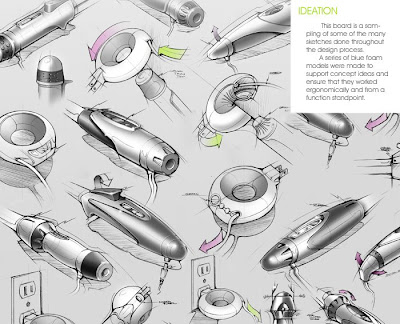
Zach then made a series of foam study models to support his concept ideas and to ensure that they worked ergonomically and from a functionality standpoint. This crucial step is vital to ensuring that his drawings hadn’t led him astray. This will also allow him to gain confidence in his functional design solutions. As his client will certainly to ask him questions relating to the functional characteristics of his design decisions.Zach-Hastings-brainstorming-concept-ideation-exploration-storyboard-3D-cad-industrial-designer-4Zach’s design solutions include the addition of a base station. The base’s primary function is for storing the power cord there by reducing visual clutter and making use safer and more enjoyable. The curling iron which in the past has been relegated to live under the cabinet or in a drawer can now be proudly displayed on the bathroom counter for easy use. Or if they prefer to keep the device out of sight they can connect the iron to the base and place them in a drawer where they are no longer tying up the other items. The end cap has a radial taper which allows for easy nesting into the base and conveys a safe touch point. The hinge point for the tong lever has shifted to an inbound element. This subtle change greatly reduces if not eliminates tangles and burns. The barrel is now ceramic coated which reduces tacking and discoloration. The controls have been simplified into buttons that can provide audible feedback to indicate a change in temperature has been made.Zach-Hastings-brainstorming-concept-ideation-exploration-storyboard-3D-cad-industrial-designer-5Overall Zach has developed a feature rich solution that has not complicated the process users are accustomed to, he has enhanced it. By reducing the stresses related to using a curling iron Zach has allowed the user to focus how their hair looks and not worry as much about accidentally burning their skin and in turn damaging their hair. Not to mention making life easier on us guys when we are sorting through the tangled web that is our bathroom drawer!

Monday, April 20, 2009

K2 Snowboard boots

Remi-Marchand-sketch-designer-snowboard-boot-concept-industrial-designeRemi Marchand has captured a transitional image that presents his functional Snowboard boot concept as both a sketch/digial rendering and as a 3D rendering. When a concept is presented in this fashion the creative director and/or client can see how the designers idea took shape. The consistency in form and proportion when the 3D model is shown in contrast with the sketch conveys the designers grasp on viable solutions and how his other unrendered sketches will accurately translate into 3D models. Not to mention it is cool to see how accuratly he is able to depict his concept in both sketch and 3D form. This work was developed while Remi was at One & Co in San Francisco, Ca. Thanks to Remi for a great example of how designers bring new life to client presentations.

EV-0 RR TTXGP zero carbon fuel Grand Prix

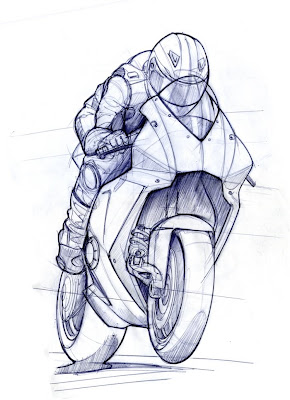
Mark Wells, Co-Founder of Xenophya Design began his career at Northumbria University. He has taken his passion for motorcycles and transformed his dream into a reality. The images you are drooling over were designed by Mark for the TTXGP. The aim of the TTXGP is to promote clean emission technologies. Mark and his partner in crime Ian Wride have delivered one hell of a knock out blow to the belief that being green means you are gonna be slow. What did you think when you first saw Marks' sketches? I imagine you were blown away by the details and clean lines he delivers in his sketches. It almost looks like he used a tool to draw every line as they appear to be created with the assistance of some device. But this is not the case. Marks ability to draw clean and fluid concepts didn't just happen overnight. He continues to hone his skills as a designer, engineer, and researcher. This is not to be forgotten if you want to be able to draw what you see in your mind as fluidly as Mark draws what he sees in his.Mark-Wells-Xenophya-designs-industrial-designer-motorcycle-concept-zero-carbonLet's break down the clean and direct pen sketch you see above. Initially you may notice the perspective lines flowing from left to right through the hub of the wheels. Mark has used them to keep the drawing in proportion and in the correct perspective. He then laid down light gestural lines to work through the proportions of the idea he had in his mind. Notice that these light gestural lines are done very quickly and are no longer as noticeable as they were in the initial minutes of his sketch. Once he defined the scale and overall position of the components of this sketch he began to digg into the heart of his thoughts about the form of the faring and overall attitude of the rider.Mark-Wells-Xenophya-designs-industrial-designer-motorcycle-concept-zero-carbon-2Mark has presented a sketch that has real emotion behind it. It immediately tells you about the mind set of the rider. How his crouched position makes him more aerodynamic and that speed is his primary concern. To look at this sketch I am immediately pulled into the moment. I feel the acceleration of the bike and my bodies challenge against gravity as I fight to hold on to the handlebars. Excellent sketches like this will bring you into the sketch and force the will of the designer upon you. His truly emotional style is one to be referenced, but not copied. Mark has worked hard to develop his own sketching style. And so will you as you practice drawing the things you see in both the physical world and your cerebral world.

Nintendo Wii Peripherals - Nerf Weapons

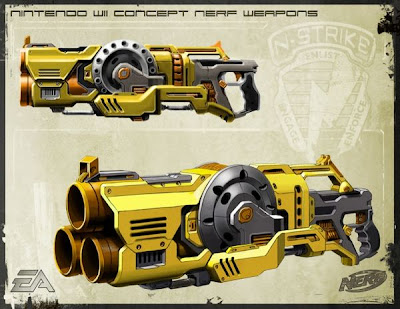
Nerf has always been a source of smiles and laughter for me. I don't ever recall not laughing about using one of their products, well then again... Never mind. Weston Boege has brought us something that gives us cause to call in sick! Weston was given the opportunity to develop a line of Wii game controllers while at Hasbro Toy Corporation based around Nerf's Brand Identity and Attitude Branding. His efforts have given me inspiration to grab my pen and a few pieces of paper. I love to see sketches like this and I am sure you will agree, they are awesome to look at. Weston loves his job and we can all tell by looking at his work.
Weston-Boege-industrial-designer-photoshop-Nerf-Wii-controller-5To break down his presentation renderings - Weston has presented two views on each of his presentation boards. One is a front 3/4 view and the other is an orthographic projection. Weston began with pen sketches, then scanned them into Photoshop and rendered them. The simplicity and straight forwardness of his drawings allows us to easily imagine ourselves using these toys. They are clearly illustrating the functionality of the product and the excitement that can be had when using one of his fantastic creations. If you look closely you can see some of the layout lines Weston used to define the proportions of his initial sketches. Layout lines allow the concept sketch to take on a life of its own and thus present the idea as a concept, allowing the brand managers or other decision makers to make changes without feeling as though the design is set in stone and unchangeable.Weston-Boege-industrial-designer-photoshop-Nerf-Wii-controller-2The emotional response people have to your designs is very important. If at all possible we make every effort for it to be a positive one. We should have had these types of peripherals back in the days of Duck Hunt and Super Mario! Although my mother probably wouldn't have gotten one for me, I would have tried to convince her until I was sent to my room!

Sunday, April 19, 2009

How do you think on paper?

Kate-Hickey-designer-Dewalt-ideation-sketches-industrial-designerThe Design Process isn't a magical facet of design. It isn't tightly held by a group of top tier designers that don't want their secrets to get out. And there isn't some trick to it... Other than listening to your consumers and being aware of the environment in which the product may be used and then developing a solution that allows the consumer to get the job done. Kate Hickey has given us a glimpse into her design process that we won't let get away. Kate has taken her experiences using similar products, her insights gained from ethnographic research, and combined them(along with great skill) to design what may be the next advances for optical lasers, compressor feet, and compressor engine covers for DeWALT. If you want to see how a great designer thinks on paper, look no further than Kate Hickey. Sketches are developed by hand then taken into Photoshop for digital detail enhancement.

Concept renderings and sketches for Nike and Adidas

Cheng-Kue-Nike-sketches-ideation-concept-industrial-designer-shoes-shoe.jpgThis is where Cheng Kue begins his thought process. With Autodesk Sketchbook Pro he can sketch and color his shoe concepts in a rapid fashion. Allowing his designs to jump off the page and into production.
Cheng-Kue-Adidas-sketches-ideation-concept-industrial-designer-shoes-shoeHere is an example of the lengths an Industrial Designer goes to ensure that color variations are not only considered but thoroughly conveyed so each retailer has their own unique colorway. Cheng Kue says that once a solid direction is selected for concept he then begins a process of illustrating the concepts in Illustrator and then brings them into Photoshop to add texture and color. Each color variation was completed in 40 - 50 minutes.